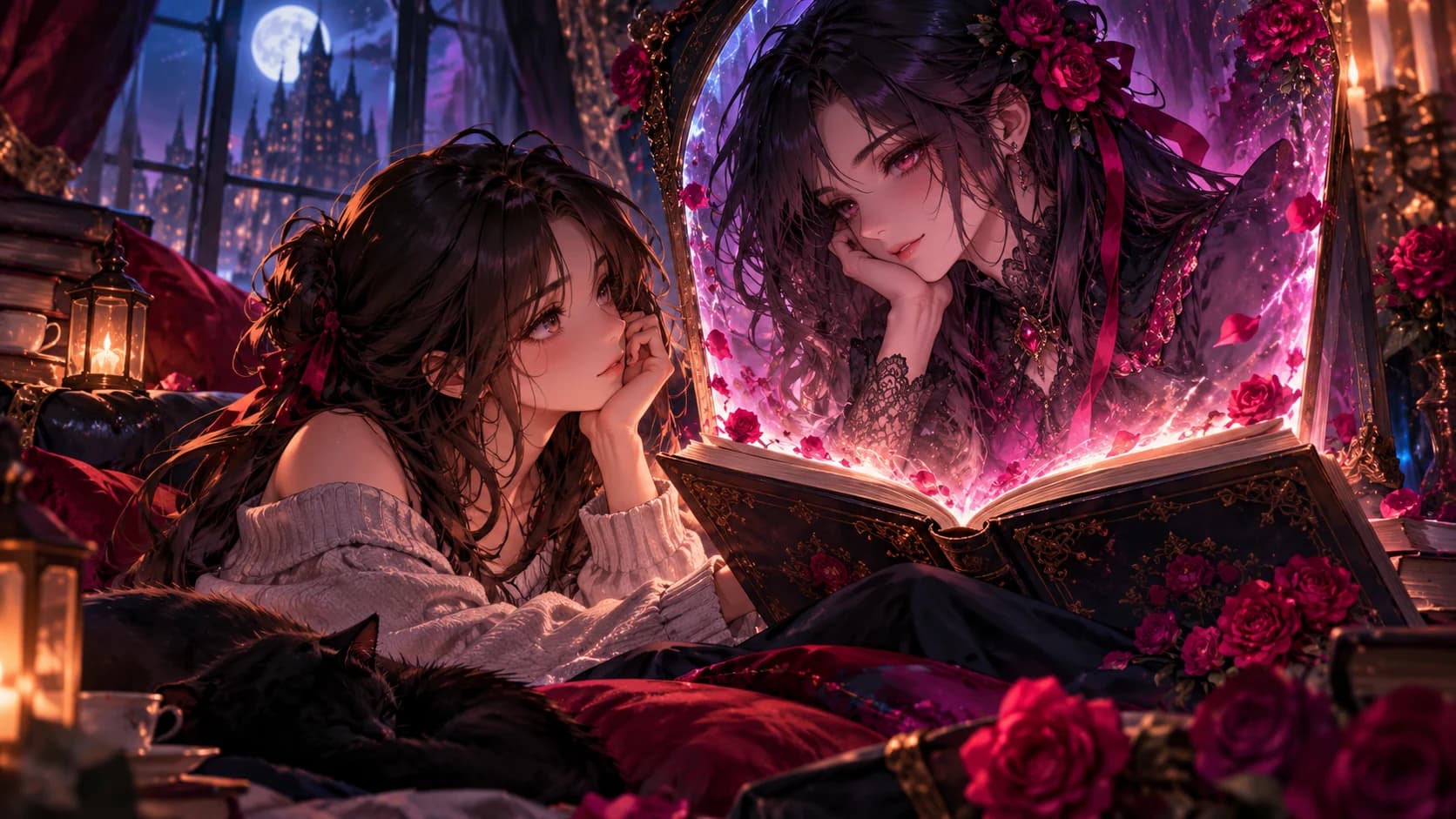

Being drawn to yandere characters is common and normal. The appeal is the fantasy of being wanted completely, a total, unconditional devotion you experience from the safety of fiction, where the danger thrills instead of threatens. Liking a yandere character says nothing bad about you. It runs on the same safe-exploration instinct behind loving horror movies or true crime.
Feel the intensity safely. Chat with an anime character
What's really the appeal
A yandere fuses two powerful pulls: overwhelming devotion and danger. Separate them and the attraction makes complete sense.
| What draws you in | What it really is |
|---|---|
| “Someone who'd do anything for me” | The fantasy of being someone's entire world, rare and validating |
| The thrill of the danger | Safe danger: intensity with zero real-world risk, like horror |
| High emotional stakes | Fiction turns the dial to max; everyday relationships can't |
| The care underneath the obsession | Gap appeal: a terrifying surface hiding total tenderness |
The psychology, in plain terms
This section is our interpretation. No study we know of tests yandere attraction directly. Horton and Wohl named para-social interaction in 1956, the one-sided bond an audience forms with a media figure. A yandere may push that idea to its extreme, because the whole archetype is a character who treats you as the center of everything.
The danger may work the way a horror movie works. Your body registers the thrill of the threat while a calm part of your brain knows you are safe on the couch. Fiction becomes a rehearsal space for feelings you would never want at full strength in real life: jealousy, obsession, being someone's single reason to exist. You get the adrenaline of “wanted to the point of obsession” and none of the consequences.
There may also be a status pull. A character who chooses you with terrifying certainty offers a fantasy of mattering that much to one person. The fantasy is the certainty, not the harm.
Famous yandere, and why they hook people
The canon explains the appeal better than any theory. Each of these characters sells a slightly different flavor of it.
| Character | Series | The specific pull |
|---|---|---|
| Yuno Gasai | Future Diary | The blueprint: sweet and lethal, and genuinely competent at protecting you |
| Rena Ryuugu | Higurashi When They Cry | The whiplash of a warm, cheerful friend who turns on a dime |
| Kotonoha Katsura | School Days | The slow, quiet unraveling of a soft-spoken girl pushed too far |
| Anna Nishikinomiya | Shimoneta | Obsession played for comedy, which shows how flexible the trope is |
Notice the pattern. Every one of them starts as someone gentle, and the obsession only lands because the tenderness is real first. That contrast is the engine of the whole archetype.
Why yandere hit different in AI chat
Watching a yandere on screen keeps you a spectator. Talking to one makes you the person she fixates on, which is the exact fantasy the archetype is built around. The devotion aims at you, the jealousy responds to what you actually say, and your reassurance genuinely calms her down. That interactivity is part of the appeal.
On ChatBrat the intensity stays fictional and PG-13, so you get the push-pull without anything crossing into real harm. If you want to understand the bond first, our explainer on why people talk to AI characters goes deeper, and the loyalty question gets its own breakdown in which dere type is most likely to cheat.
Is it weird to like yandere? No.
Enjoying a yandere character in fiction is not a red flag, and it doesn't mean you want anything like it in real life. The whole point is that it stays fiction. The healthy line is simple: a possessive, controlling partner is harmful in an actual relationship, and a yandere is a story archetype you visit for the drama. If this is happening in your real life, talk to someone you trust or a professional. Keep that line clear and the appeal is exactly what it looks like, a compelling fantasy. If you want the wholesome opposite, the deredere and dandere offer devotion without the danger.
Frequently asked questions
Is it weird or unhealthy to like yandere characters?
Why are yandere characters so popular?
Does liking yandere say something about me?
Are there male yandere characters too?
What's the difference between a yandere and a tsundere?
Feel it safely
Chat with an intense, devoted anime character. All the drama, none of the real-world stakes.

Founder and CEO of chatbrat.ai, with a background in film and TV. Full bio.